

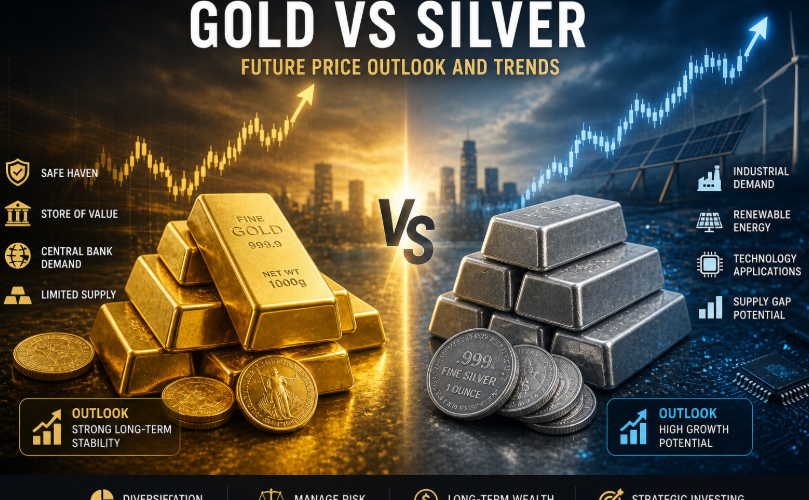
Understanding the gold vs silver future outlook is essential for investors who want to position themselves for long-term success. Both metals have held value for centuries, yet their price behavior continues to evolve based on economic shifts, global demand, and technological changes. Therefore, analyzing where each metal may head next can help investors make more informed decisions.
At first glance, gold and silver appear to move together, but their underlying drivers are quite different. While gold is often seen as a store of value, silver plays a dual role as both an industrial and investment asset. As a result, the gold vs silver future debate depends heavily on how these forces interact over time.
Key Factors Driving Future Prices
Several major factors influence the future price direction of precious metals. Economic growth, inflation, and interest rates all play a role in shaping demand. Because of this, understanding these drivers is critical when evaluating the gold vs silver future outlook.
Inflation remains one of the most important influences. When inflation rises, investors typically seek assets that preserve purchasing power. Gold often benefits directly from this trend due to its reputation as a hedge. Meanwhile, silver may also gain, although its performance can vary depending on industrial demand.
Interest rates also impact both metals. Higher rates tend to reduce the appeal of non-yielding assets like gold and silver. However, if rates remain low or unstable, demand for precious metals may increase. Consequently, the gold vs silver future outlook often shifts based on central bank policies.
Gold’s Long-Term Stability and Demand
Gold has consistently been viewed as a safe-haven asset. During times of economic uncertainty, investors turn to gold for stability. This behavior supports long-term demand and strengthens the gold vs silver future argument in favor of gold for risk-averse investors.
Central banks play a major role in gold demand. Many countries continue to accumulate gold reserves to diversify their holdings. This steady demand provides a strong foundation for long-term price stability.
Additionally, gold’s limited supply adds to its appeal. Mining production grows slowly, which helps maintain its value over time. Therefore, when considering the gold vs silver future, gold’s scarcity and stability often give it a significant advantage.
Silver’s Growth Potential and Industrial Use
Silver’s future outlook is closely tied to industrial demand. Unlike gold, silver is widely used in technology, renewable energy, and manufacturing. As industries expand, demand for silver may increase significantly.
For example, solar panels, electric vehicles, and electronics all rely on silver components. As these sectors grow, silver consumption could rise sharply. This trend is a key factor in the gold vs silver future discussion, especially for investors seeking growth opportunities.
However, silver’s reliance on industry also introduces risk. Economic slowdowns can reduce demand, leading to price fluctuations. Therefore, while silver offers strong upside potential, it also carries higher volatility compared to gold.
Supply Constraints and Market Dynamics
Supply plays a critical role in determining future prices. Gold supply is relatively stable, with production increasing gradually. This stability supports consistent pricing and reinforces its position in the gold vs silver future outlook.
Silver supply, on the other hand, is more complex. Much of the silver produced comes as a byproduct of other mining activities. As a result, its supply can fluctuate based on the production of other metals.
Additionally, increasing demand for silver in technology may strain supply in the future. If demand outpaces production, prices could rise significantly. Therefore, supply dynamics add another layer to the gold vs silver future analysis.
Volatility and Investment Risk
Volatility is an important consideration for investors. Gold tends to experience smaller price swings, making it a more stable investment. During uncertain times, this stability becomes particularly valuable.
Silver, however, is known for its higher volatility. While this can lead to greater gains, it also increases risk. Therefore, investors must carefully evaluate their risk tolerance when considering the gold vs silver future outlook.
Market sentiment can amplify these movements. When investors are optimistic, silver may outperform due to its growth potential. Conversely, during periods of fear, gold often becomes the preferred choice.
Technological Trends and Future Demand
Technological advancements are shaping the future of precious metals. As industries evolve, the demand for silver is expected to grow. Renewable energy, in particular, is a major driver of future silver consumption.
Gold, while less tied to industry, benefits from technological innovation in other ways. For example, digital trading platforms and increased accessibility have expanded its investor base. As a result, the gold vs silver future outlook includes both traditional and modern influences.
Furthermore, emerging technologies may create new uses for both metals. These developments could impact demand and pricing in unexpected ways. Therefore, staying informed about technological trends is essential.
Global Economic Influence
Global economic conditions play a significant role in shaping metal prices. During periods of instability, gold often performs well due to its safe-haven status. This trend strengthens its position in the gold vs silver future comparison.
Silver, meanwhile, tends to perform better during economic expansion. As industries grow, demand for silver increases, supporting higher prices. Therefore, the performance of each metal often depends on the broader economic environment.
Currency movements also influence both metals. When currencies weaken, precious metals become more attractive. As a result, global economic shifts can significantly impact the gold vs silver future outlook.
Diversification and Investment Strategy
Diversification is a key principle in investing. Holding both gold and silver can provide a balanced approach. Gold offers stability, while silver provides growth potential. Therefore, combining both metals can enhance portfolio resilience.
Investors often use gold to protect against economic downturns. At the same time, silver can be used to capitalize on industrial growth. This combination allows investors to benefit from different market conditions.
Additionally, diversification reduces overall risk. By spreading investments across multiple assets, investors can better manage volatility. As a result, the gold vs silver future outlook becomes more balanced when both metals are included.
Market Cycles and Timing Considerations
Market cycles influence the performance of precious metals. During downturns, gold often outperforms due to increased demand for safety. As markets recover, silver may gain momentum due to rising industrial activity.
Understanding these cycles can help investors make better decisions. However, timing the market perfectly is difficult. Instead, focusing on long-term trends can provide more consistent results.
Regular investing can also help manage timing risks. By investing consistently, investors can take advantage of price fluctuations without relying on perfect timing. Therefore, this approach supports a more stable gold vs silver future strategy.
Psychological Factors in Investment Decisions
Investor psychology plays a significant role in market behavior. Fear and uncertainty often drive demand for gold, reinforcing its stability. As a result, gold remains a popular choice during volatile periods.
Silver, while still valuable, may not attract the same level of emotional demand. Investors often prioritize security over growth during uncertain times. Therefore, psychological factors influence the gold vs silver future outlook.
Understanding these behaviors can help investors make more rational decisions. By focusing on fundamentals rather than emotions, they can navigate markets more effectively.
Conclusion
The gold vs silver future outlook highlights the unique strengths of each metal. Gold offers stability, consistent demand, and protection during economic uncertainty. Silver, on the other hand, provides growth potential driven by industrial demand and technological advancement.
While gold is often the safer choice, silver presents opportunities for higher returns. Therefore, the best approach may involve combining both metals to balance risk and reward.
Ultimately, the choice depends on your investment goals and risk tolerance. By understanding the factors that influence each metal, you can build a strategy that aligns with your financial objectives and prepares you for future market trends.
FAQ
1. Which metal has better long-term stability?
Gold generally offers more stability due to consistent demand and its role as a store of value.
2. Why is silver considered a growth asset?
Silver’s industrial use in technology and renewable energy drives its growth potential.
3. Can silver outperform gold in the future?
Yes, especially during economic expansion when industrial demand increases.
4. Is it better to invest in both metals?
Diversifying with both can balance stability and growth in your portfolio.
5. How do economic conditions affect precious metals?
Gold performs well during uncertainty, while silver often benefits from economic growth.