

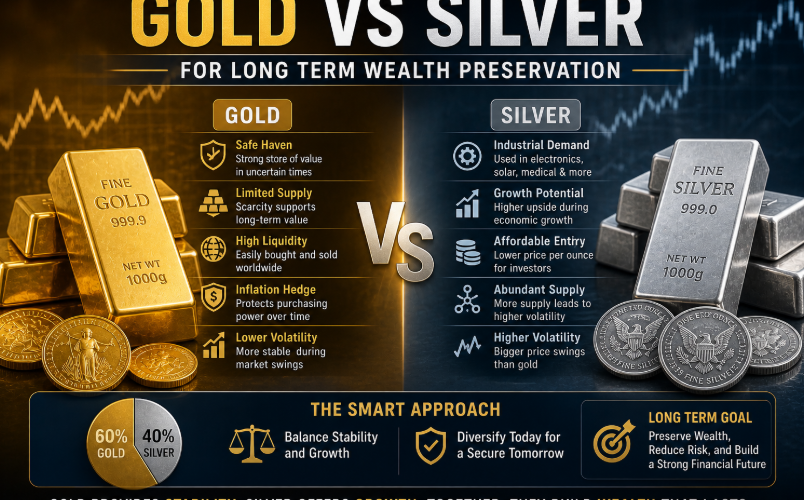
Understanding gold vs silver wealth preservation is essential for investors who want to secure their financial future over time. While both metals have proven their value across generations, they serve different purposes in a long-term strategy. Therefore, choosing between them requires more than preference; it demands a clear understanding of how each performs under changing economic conditions.
At a basic level, both gold and silver act as stores of value. However, their price behavior, demand drivers, and risk profiles differ significantly. As a result, the gold vs silver wealth preservation debate often depends on whether you prioritize stability or growth. By exploring these differences, you can build a more balanced and resilient investment approach.
Why Precious Metals Matter for Long-Term Wealth
Precious metals have stood the test of time as reliable assets. Unlike paper currency, they are not tied directly to government policies or central bank decisions. Because of this independence, they often retain value even when traditional markets struggle.
Gold has long been associated with wealth preservation. It is widely accepted and recognized across the globe. Meanwhile, silver offers additional benefits due to its industrial use. Therefore, both metals play important roles in gold vs silver wealth preservation strategies.
Additionally, precious metals act as a hedge against inflation. When currency loses value, metals often maintain or increase their worth. As a result, they provide a layer of protection that supports long-term financial stability.
Gold’s Role as a Stable Store of Value
Gold is often the first choice for investors focused on preserving wealth. Its price tends to remain relatively stable compared to other assets. During periods of economic uncertainty, demand for gold typically increases, supporting its value.
One key advantage of gold is its limited supply. Mining production grows slowly, which helps maintain scarcity. This scarcity strengthens its position in gold vs silver wealth preservation strategies.
Moreover, gold is highly liquid. Investors can easily buy or sell it in global markets. This accessibility adds to its appeal, especially for those who value flexibility. As a result, gold continues to be a cornerstone of long-term wealth preservation.
Silver’s Growth Potential and Versatility
Silver offers a different set of advantages. While it also serves as a store of value, its industrial applications create additional demand. Industries such as electronics, renewable energy, and manufacturing rely heavily on silver.
Because of this dual role, silver has greater growth potential. When economies expand, industrial demand increases, driving prices higher. Therefore, silver can provide higher returns in certain conditions.
However, this potential comes with increased volatility. Silver prices tend to fluctuate more than gold. As a result, investors must carefully consider risk when evaluating gold vs silver wealth preservation options.
Volatility and Risk Differences
Risk tolerance plays a crucial role in choosing between gold and silver. Gold’s stability makes it a safer option for conservative investors. It experiences fewer dramatic price swings, which helps protect value over time.
In contrast, silver’s volatility can lead to both gains and losses. While this creates opportunities, it also increases uncertainty. Therefore, understanding your comfort with risk is essential in gold vs silver wealth preservation decisions.
Market sentiment can also influence volatility. During uncertain times, investors often prefer gold for its reliability. Meanwhile, silver may experience mixed demand due to its industrial ties. As a result, gold typically provides more consistent performance.
Liquidity and Accessibility Considerations
Liquidity is another important factor. Gold markets are larger and more established, making transactions easier. Investors can quickly convert gold into cash without significant price changes.
Silver markets, while active, are smaller. This can lead to wider price spreads and slightly slower transactions. Therefore, liquidity often favors gold in gold vs silver wealth preservation strategies.
Additionally, storage plays a role. Gold’s higher value per ounce makes it easier to store and transport. Silver requires more space due to its lower value density. As a result, logistics may influence your decision.
Inflation Protection and Currency Hedge
Both metals serve as protection against inflation, but gold is often more reliable in this role. When inflation rises, gold prices typically increase as investors seek stability. This behavior strengthens its position in gold vs silver wealth preservation.
Silver can also benefit from inflation, but its response is less consistent. Industrial demand may weaken during economic slowdowns, affecting its performance. Therefore, gold generally provides stronger protection against currency devaluation.
Currency fluctuations further highlight these differences. Gold’s global acceptance makes it a preferred hedge during currency instability. As a result, it remains a key asset for preserving purchasing power.
Long-Term Performance Trends
Looking at historical trends provides valuable insight. Gold has consistently maintained its value over long periods, making it a reliable choice for wealth preservation. Its steady performance supports its role in gold vs silver wealth preservation strategies.
Silver, on the other hand, has shown periods of strong growth followed by declines. While it can outperform gold during certain cycles, its performance is less predictable. Therefore, investors must weigh potential rewards against risks.
Despite these differences, both metals have contributed to successful portfolios. Gold offers stability, while silver provides growth potential. Combining both can create a more balanced approach.
Diversification for Stronger Wealth Protection
Diversification is a fundamental principle of investing. By holding both gold and silver, you can benefit from their unique strengths. This approach reduces reliance on a single asset and improves overall resilience.
Gold provides a stable foundation, while silver adds growth opportunities. Together, they create a balanced portfolio that can adapt to changing conditions. Therefore, diversification is central to effective gold vs silver wealth preservation strategies.
Additionally, including other asset classes can further enhance stability. Stocks, bonds, and real estate each offer different benefits. By combining these elements, you can build a comprehensive investment plan.
Psychological Factors in Investment Choices
Investor psychology often influences decisions more than data. During uncertain times, fear drives demand for gold. Its reputation as a safe haven provides comfort and confidence.
Silver, while valuable, may not offer the same emotional reassurance. Investors often prioritize stability over growth during downturns. Therefore, psychological factors play a role in gold vs silver wealth preservation decisions.
Understanding these influences can help you make more rational choices. By focusing on long-term goals rather than short-term emotions, you can improve your investment outcomes.
Practical Strategy for Long-Term Investors
Building a long-term strategy requires careful planning. Start by defining your financial goals and risk tolerance. This clarity helps determine the right balance between gold and silver.
Next, allocate your investments accordingly. Conservative investors may prefer a higher proportion of gold. Those seeking growth may include more silver. Therefore, customization is key in gold vs silver wealth preservation planning.
Regularly reviewing your portfolio is also important. Market conditions change, and your strategy should adapt. By staying proactive, you can maintain alignment with your goals.
Conclusion
Gold vs silver wealth preservation is not about choosing one over the other but understanding how each contributes to your financial strategy. Gold offers stability, reliability, and protection during uncertainty. Silver provides growth potential and exposure to industrial demand.
While gold is often the safer choice, silver can enhance returns when used strategically. Therefore, combining both metals creates a balanced approach that supports long-term success.
Ultimately, the best strategy depends on your goals and risk tolerance. By understanding the strengths and limitations of each metal, you can build a portfolio that preserves wealth and adapts to changing market conditions.
FAQ
1. Which metal is better for long-term stability?
Gold is generally more stable and is widely used for preserving wealth over long periods.
2. Can silver outperform gold over time?
Yes, silver can outperform gold during periods of strong industrial demand and economic growth.
3. Is it safe to invest only in precious metals?
Diversification is recommended, as relying on a single asset class can increase risk.
4. How does inflation affect these metals?
Gold typically performs well during inflation, while silver’s performance may vary.
5. Should beginners invest in both metals?
Yes, holding both can provide a balance of stability and growth potential.