

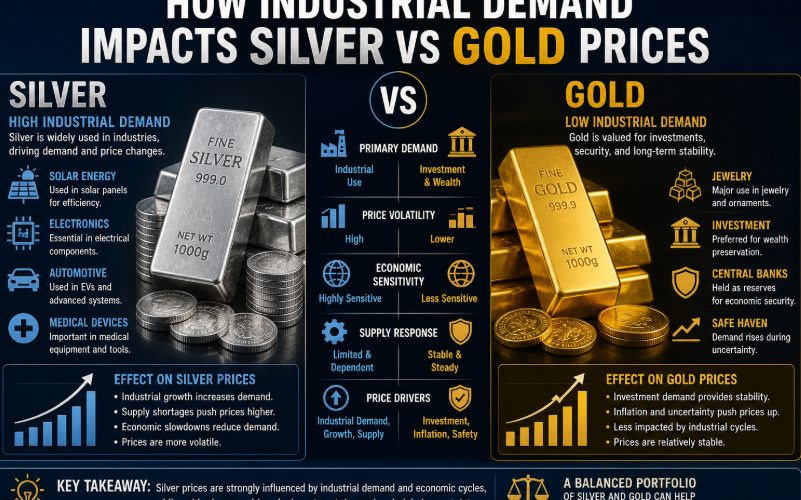
Understanding how industrial demand silver gold influences price movements is essential for investors who want to make informed decisions. While both metals are valuable, they respond differently to economic forces. Gold is primarily driven by investment demand, whereas silver is heavily influenced by industrial use. Therefore, analyzing how industry affects each metal provides insight into their price behavior.
At a deeper level, silver’s role in manufacturing creates a unique dynamic. It is used in electronics, renewable energy, and medical applications. Meanwhile, gold’s demand is more stable because it is less tied to industrial activity. As a result, industrial demand silver gold becomes a key factor when comparing price trends and market reactions.
The Fundamental Difference Between Gold and Silver Demand
Gold and silver differ in how demand shapes their prices. Gold is often seen as a store of value, which keeps its demand relatively consistent. Investors rely on it during uncertain times, which supports its stability.
Silver, however, depends heavily on industrial consumption. When economies grow, demand for silver increases due to higher production levels. As a result, industrial demand silver gold creates a clear contrast between the two metals.
Additionally, this difference affects volatility. Gold tends to move steadily, while silver experiences sharper price swings. Therefore, understanding these dynamics helps investors anticipate how prices may change.
How Industrial Growth Drives Silver Prices
Industrial expansion directly impacts silver prices. As industries produce more goods, they require more raw materials. Silver is widely used in electronics, solar panels, and automotive components, making it essential for modern technology.
When demand for these products rises, silver consumption increases. Consequently, prices often move higher. This relationship highlights how industrial demand silver gold plays a critical role in silver’s price performance.
However, this connection also introduces risk. If industrial activity slows, demand for silver may decline. As a result, prices can fall quickly, reflecting changes in economic conditions.
Why Gold Remains Less Affected by Industry
Gold’s price is less influenced by industrial demand. While it does have some industrial applications, they represent a smaller portion of total demand. Instead, gold is driven by investment, jewelry, and central bank reserves.
Because of this, gold is more stable during economic fluctuations. Investors often turn to gold during uncertainty, which supports its price. Therefore, industrial demand silver gold impacts gold less directly compared to silver.
Additionally, gold’s global recognition reinforces its value. It is widely accepted as a hedge against inflation and currency instability. As a result, its price movements are more predictable.
Economic Cycles and Their Influence
Economic cycles play a major role in shaping demand for both metals. During periods of growth, industrial activity increases, boosting silver demand. As a result, silver prices often rise faster than gold during expansions.
In contrast, during economic downturns, industrial demand declines. This reduction can lead to falling silver prices. Meanwhile, gold may perform better as investors seek safety. Therefore, industrial demand silver gold creates different outcomes depending on the economic cycle.
Understanding these patterns helps investors adjust their strategies. By recognizing where the economy stands, they can better anticipate price movements.
The Role of Technology and Innovation
Technological advancements are increasing the importance of silver. Renewable energy, particularly solar power, relies heavily on silver components. As global demand for clean energy grows, silver consumption is expected to rise.
This trend strengthens the connection between industrial demand silver gold and future price potential. Silver’s role in innovation gives it a unique advantage compared to gold.
Gold, while less tied to technology, benefits from innovation in other ways. Improved trading platforms and increased accessibility have expanded its investor base. As a result, both metals are influenced by technological progress, but in different ways.
Supply and Demand Imbalance Effects
Supply constraints can amplify the impact of demand. Silver production often depends on mining other metals, which can limit supply flexibility. When demand rises quickly, supply may struggle to keep up, driving prices higher.
This imbalance highlights how industrial demand silver gold can create strong price movements. Silver’s reliance on industrial use makes it more sensitive to supply changes.
Gold supply, on the other hand, is more stable. Mining production grows slowly, which helps maintain balance. Therefore, gold prices are less affected by sudden supply shifts.
Market Volatility and Investment Risk
Volatility is a key consideration for investors. Silver’s dependence on industrial demand leads to greater price fluctuations. While this can create opportunities, it also increases risk.
Gold’s stability makes it a safer option during uncertain times. Investors often choose gold when they want to reduce exposure to volatility. Therefore, industrial demand silver gold influences risk levels in different ways.
Additionally, market sentiment can amplify these effects. During optimistic periods, silver may outperform due to growth expectations. During fear-driven markets, gold often becomes the preferred asset.
Global Demand and Economic Shifts
Global demand plays a significant role in determining prices. Emerging markets, industrial growth, and infrastructure development all increase the need for silver. As a result, industrial demand silver gold is closely tied to global economic trends.
Gold demand, however, is influenced by different factors. Currency movements, inflation, and geopolitical events often drive gold prices. Therefore, gold responds more to financial conditions than industrial activity.
These differences highlight the importance of understanding global influences. Investors who monitor these trends can better position themselves for market changes.
Diversification and Strategic Investing
Diversification is essential for managing risk. Combining gold and silver in a portfolio allows investors to benefit from both stability and growth potential. Gold provides protection, while silver offers opportunities tied to industrial expansion.
This balance is a key advantage of industrial demand silver gold strategies. By holding both metals, investors can adapt to changing market conditions.
Additionally, diversification reduces reliance on a single asset. When one metal underperforms, the other may compensate. Therefore, a balanced approach supports long-term success.
Practical Considerations for Investors
When deciding between gold and silver, investors should consider their goals. Those seeking stability may prefer gold, while those looking for growth may choose silver.
Monitoring industrial trends is also important. Changes in technology, manufacturing, and global demand can influence silver prices. Therefore, understanding industrial demand silver gold helps guide investment decisions.
Additionally, timing plays a role. Economic conditions can shift quickly, affecting both metals. By staying informed, investors can make more strategic choices.
Conclusion
Industrial demand silver gold plays a crucial role in shaping the price dynamics of both metals. While gold remains stable due to its investment appeal, silver’s connection to industry creates both opportunities and risks. Understanding these differences allows investors to make informed decisions.
Silver’s growth potential is driven by technological and industrial expansion, while gold offers consistent protection during uncertainty. By combining both metals, investors can create a balanced strategy that adapts to changing conditions.
Ultimately, the choice between gold and silver depends on your investment goals and risk tolerance. By recognizing how industrial demand affects each metal, you can build a more resilient and effective portfolio.
FAQ
1. Why does silver react more to industrial changes than gold?
Silver is widely used in manufacturing and technology, making its demand closely tied to industrial activity.
2. Does gold have any industrial use?
Yes, but it is limited compared to silver, so it has less impact on gold prices.
3. Can silver outperform gold during economic growth?
Yes, increased industrial demand can drive stronger price gains for silver during expansion.
4. Is gold safer than silver for investors?
Gold is generally more stable, making it a safer option during uncertain market conditions.
5. Should investors track industrial trends for precious metals?
Yes, especially for silver, as industrial demand significantly influences its price movements.