

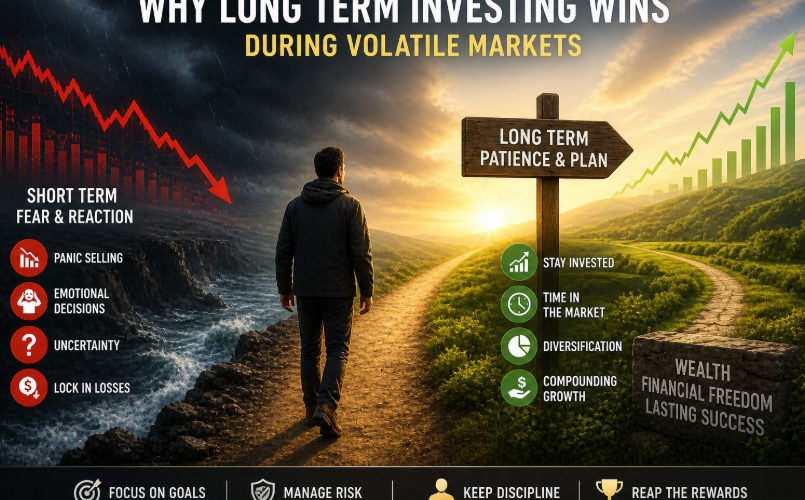
Understanding why long term investing volatile markets strategies outperform short-term reactions can completely change how you approach investing. Markets will always fluctuate, sometimes sharply, and these movements often trigger fear and confusion. However, investors who focus on long-term growth rather than short-term noise tend to see better and more consistent results over time.
At first, volatility may seem like a threat. Prices rise and fall unpredictably, and sudden drops can make even experienced investors uneasy. Yet, when you look deeper, volatility is simply a natural part of the market cycle. Therefore, those who embrace a long term investing volatile markets approach are better equipped to handle uncertainty without making emotional decisions.
Why Market Volatility Is Not the Enemy
Many investors mistakenly believe that volatility is something to avoid. In reality, it is an essential part of how markets function. Without price movements, there would be no opportunities to buy or sell assets at favorable levels. Because of this, long term investing volatile markets strategies rely on understanding, not fearing, these fluctuations.
Volatility often reflects changing expectations. Economic data, interest rates, and global events all influence investor sentiment. As a result, prices adjust quickly to new information. While these movements may seem chaotic, they are part of a broader system that balances supply and demand.
Moreover, volatility can create opportunities. When prices drop, quality assets may become undervalued. Investors who maintain a long-term perspective can take advantage of these moments rather than reacting with fear. Consequently, volatility becomes a tool rather than a threat.
The Power of Time in Investment Growth
Time is one of the most powerful factors in investing. The longer you stay invested, the more you benefit from compounding returns. This is why long term investing volatile markets strategies emphasize patience and consistency over quick gains.
Short-term market movements are unpredictable. Even experts struggle to forecast daily or weekly changes accurately. However, over longer periods, markets tend to grow. Therefore, focusing on time in the market rather than timing the market is often a more effective approach.
Compounding also plays a crucial role. When returns are reinvested, they generate additional earnings over time. This process accelerates growth, especially during stable periods following volatility. As a result, investors who stay committed to long term investing volatile markets strategies often see exponential growth.
Emotional Discipline and Investor Behavior
Emotions can significantly impact investment decisions. Fear and greed often drive actions that go against long-term goals. During market downturns, fear may lead to panic selling, while during rallies, greed may encourage risky behavior. Therefore, maintaining emotional discipline is essential for success.
Long term investing volatile markets strategies help reduce emotional decision-making. By focusing on a clear plan, investors are less likely to react impulsively. Instead, they follow a structured approach that prioritizes long-term outcomes.
Additionally, understanding behavioral biases can improve decision-making. Recognizing patterns such as loss aversion or herd behavior allows investors to avoid common mistakes. As a result, they can stay focused even during periods of uncertainty.
Why Trying to Time the Market Often Fails
Many investors attempt to predict market movements in order to buy low and sell high. While this idea is appealing, it is extremely difficult to execute consistently. Missing just a few of the best market days can significantly reduce overall returns. Therefore, long term investing volatile markets strategies discourage frequent trading.
Market timing requires accurate predictions, which are nearly impossible due to the number of variables involved. Economic changes, political events, and unexpected developments can all influence prices. Because of this complexity, even experienced investors often struggle to time the market effectively.
Instead, staying invested allows you to benefit from overall market growth. By remaining consistent, you avoid the risk of missing key opportunities. Consequently, long term investing volatile markets approaches tend to produce more reliable results.
How Volatility Creates Buying Opportunities
Volatility often leads to temporary price declines, which can create attractive entry points. When quality assets become undervalued, investors have the chance to buy at lower prices. This strategy is a key component of long term investing volatile markets success.
Rather than viewing market drops as losses, experienced investors see them as opportunities. By purchasing during downturns, they position themselves for future gains when prices recover. Therefore, volatility becomes an advantage rather than a disadvantage.
Dollar-cost averaging is another effective technique. By investing regularly, regardless of market conditions, you reduce the impact of volatility. This approach allows you to buy more shares when prices are low and fewer when prices are high, balancing your overall investment.
Diversification as a Stability Tool
Diversification is a fundamental principle of investing. By spreading investments across different asset classes, sectors, and regions, you reduce overall risk. This strategy is particularly useful in long term investing volatile markets environments.
When one asset declines, others may remain stable or even increase in value. This balance helps protect your portfolio from significant losses. As a result, diversification provides stability during uncertain times.
Additionally, diversification allows you to participate in multiple growth opportunities. Instead of relying on a single investment, you benefit from a broader range of assets. Therefore, your portfolio becomes more resilient to market fluctuations.
The Role of Patience in Financial Success
Patience is often overlooked but is critical for long-term investing. Markets do not move in straight lines, and periods of volatility are inevitable. However, those who remain patient are more likely to achieve their financial goals.
Long term investing volatile markets strategies emphasize staying the course. Instead of reacting to short-term changes, investors focus on long-term growth. This approach reduces stress and improves decision-making.
Moreover, patience allows investments to recover from downturns. While short-term losses may occur, long-term trends often show upward movement. Therefore, maintaining patience can lead to better outcomes over time.
Building Confidence Through Knowledge and Planning
Confidence comes from understanding and preparation. Investors who educate themselves about market behavior are better equipped to handle volatility. They recognize patterns and understand that fluctuations are part of the process.
Creating a clear investment plan also builds confidence. When you know your goals and strategy, you are less likely to be influenced by market noise. As a result, long term investing volatile markets approaches become easier to follow.
Regular portfolio reviews can also help. By assessing performance and making adjustments when necessary, you maintain control over your investments. This proactive approach reduces uncertainty and strengthens confidence.
Turning Market Uncertainty Into Advantage
Uncertainty is often seen as a risk, but it can also be an opportunity. Markets reward those who are willing to stay committed during challenging times. By maintaining a long-term perspective, you can turn volatility into an advantage.
Investors who remain calm during downturns are often able to capitalize on lower prices. They understand that market cycles include both declines and recoveries. Therefore, they use uncertainty as a chance to strengthen their portfolios.
Additionally, having a strategy in place allows you to act with confidence. Instead of hesitating, you can make informed decisions based on your long-term goals. This mindset is essential for success in long term investing volatile markets.
Conclusion
Long term investing volatile markets strategies consistently outperform short-term reactions because they focus on patience, discipline, and growth. While volatility may create uncertainty, it also provides opportunities for those who are prepared.
By understanding market behavior, managing emotions, and staying committed to a plan, investors can navigate even the most challenging conditions. Over time, this approach leads to more stable and consistent results.
Ultimately, success in investing is not about avoiding volatility but learning how to work with it. When you embrace a long-term perspective, you can turn market fluctuations into a powerful advantage and achieve lasting financial success.
FAQ
1. Why is long-term investing more effective during market swings?
Long-term investing helps smooth out short-term fluctuations and allows investors to benefit from overall market growth.
2. Can volatility actually help investors?
Yes, it can create opportunities to buy assets at lower prices and improve long-term returns.
3. How does patience impact investment success?
Patience allows investments to recover from downturns and benefit from compounding over time.
4. Is diversification important in uncertain markets?
Diversification helps reduce risk by spreading investments across different assets and sectors.
5. Should investors avoid checking their portfolios frequently?
Limiting frequent checks can reduce emotional reactions and help maintain a long-term focus.