

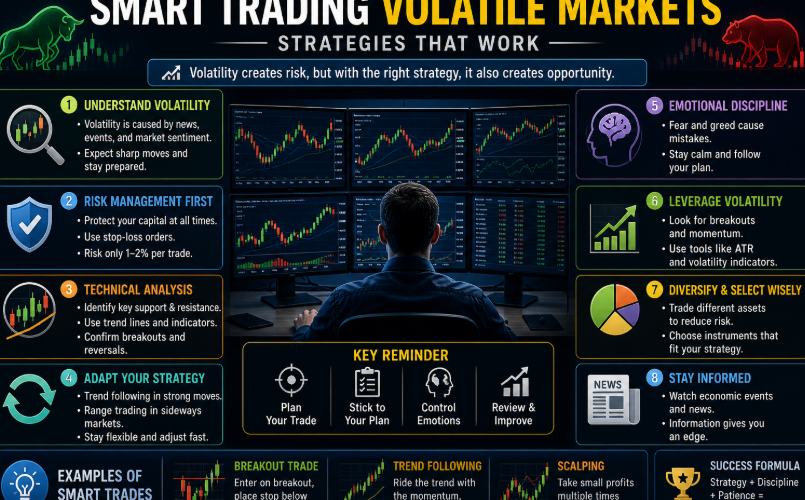
Learning how to apply smart trading volatile markets strategies can make a major difference in your success as a trader. Volatility creates both risk and opportunity, often at the same time. Prices can move quickly, and without a clear plan, it is easy to make emotional decisions. However, traders who understand how to manage these conditions can turn uncertainty into a powerful advantage.
At its core, volatility reflects rapid changes in market sentiment. While this may seem intimidating, it also creates opportunities for profit. Therefore, mastering smart trading volatile markets techniques allows you to stay focused, manage risk, and act with confidence during unpredictable conditions.
Understanding Why Markets Become Volatile
Markets become volatile for many reasons, including economic data, geopolitical events, and changes in investor sentiment. When expectations shift quickly, prices react just as fast. As a result, volatility increases and trading becomes more challenging.
Uncertainty is a key driver. When traders are unsure about future outcomes, they react more aggressively to news. Consequently, this behavior leads to larger price swings. Understanding these patterns is essential for smart trading volatile markets strategies.
Additionally, liquidity can influence volatility. When fewer buyers and sellers are present, price movements become more pronounced. Therefore, recognizing these conditions helps traders prepare for sudden changes.
The Importance of Risk Management
Risk management is the foundation of successful trading. Without it, even the best strategies can fail. In volatile conditions, managing risk becomes even more critical. Therefore, smart trading volatile markets approaches always prioritize capital preservation.
One effective method is setting stop-loss orders. These orders limit potential losses by automatically closing positions at predefined levels. As a result, traders can protect their capital without constant monitoring.
Position sizing is another important factor. By limiting the size of each trade, you reduce the impact of losses. This approach helps maintain stability even during unpredictable market movements.
Using Technical Analysis for Better Timing
Technical analysis plays a key role in identifying trading opportunities. By analyzing price charts and patterns, traders can anticipate potential movements. Therefore, it is an essential tool for smart trading volatile markets conditions.
Support and resistance levels are particularly useful. These levels indicate where prices may reverse or accelerate. When prices break through these levels, it often signals increased momentum.
Moving averages can also provide valuable insights. They help identify trends and potential entry points. By combining multiple indicators, traders can improve their decision-making process.
Adapting Strategies to Market Conditions
Flexibility is crucial when trading in volatile markets. Strategies that work in stable conditions may not perform well during periods of uncertainty. Therefore, adapting your approach is essential for success.
For example, shorter time frames may be more effective during high volatility. Quick trades allow you to capture price movements without prolonged exposure. As a result, traders can reduce risk while taking advantage of opportunities.
Additionally, using a mix of strategies can improve results. Combining trend-following and range-trading techniques allows you to respond to different market conditions. This adaptability is a key component of smart trading volatile markets success.
The Role of Emotional Discipline
Emotions can significantly impact trading decisions. Fear and greed often lead to mistakes, especially during volatile periods. Therefore, maintaining emotional discipline is essential for consistent performance.
Fear may cause traders to exit positions too early. On the other hand, greed may lead to overtrading or excessive risk-taking. By recognizing these tendencies, traders can avoid common pitfalls.
Developing a clear trading plan helps reduce emotional influence. When decisions are based on strategy rather than feelings, outcomes become more consistent. As a result, traders can execute smart trading volatile markets strategies with greater confidence.
Leveraging Volatility for Profit Opportunities
While volatility increases risk, it also creates opportunities. Rapid price movements can lead to significant gains for prepared traders. Therefore, understanding how to leverage volatility is key.
Breakout trading is one effective approach. When prices move beyond established levels, they often continue in that direction. Traders can capitalize on these movements by entering positions early.
Scalping is another strategy. This involves making multiple small trades to capture quick profits. While it requires focus and precision, it can be effective in volatile conditions.
Additionally, volatility indicators can help identify opportunities. Tools such as the Average True Range provide insights into market activity. By using these tools, traders can refine their smart trading volatile markets strategies.
Diversification and Asset Selection
Diversification is not just for long-term investors. Traders can also benefit from spreading risk across different assets. By trading multiple markets, you reduce dependence on a single asset.
Different assets respond differently to volatility. For example, commodities, currencies, and stocks each have unique characteristics. Therefore, selecting the right assets can improve overall performance.
Additionally, some markets are more volatile than others. Understanding these differences allows traders to choose opportunities that align with their risk tolerance.
The Importance of Staying Informed
Information is a powerful tool in trading. Economic reports, earnings announcements, and global events can all influence market movements. Therefore, staying informed is essential for smart trading volatile markets strategies.
However, too much information can be overwhelming. Focusing on key indicators and reliable sources helps maintain clarity. By filtering out noise, traders can make more informed decisions.
Timing also matters. Markets often react quickly to news, so being prepared is important. By anticipating potential events, traders can position themselves effectively.
Building a Consistent Trading Routine
Consistency is key to long-term success. Developing a routine helps traders stay disciplined and focused. This structure is especially important in volatile markets.
Start by setting clear goals for each trading session. Knowing what you want to achieve helps guide your actions. Additionally, reviewing past trades can provide valuable insights.
Tracking performance is another important step. By analyzing results, traders can identify strengths and weaknesses. As a result, they can refine their smart trading volatile markets strategies over time.
Common Mistakes to Avoid
Even experienced traders can make mistakes during volatile conditions. One common error is overtrading. Frequent trades increase transaction costs and reduce overall profitability.
Another mistake is ignoring risk management. Without proper controls, losses can escalate quickly. Therefore, maintaining discipline is essential.
Chasing trends is also risky. Entering trades too late can lead to losses if the trend reverses. By staying patient and following a plan, traders can avoid these pitfalls.
Conclusion
Smart trading volatile markets strategies provide a framework for navigating uncertainty with confidence. While volatility can be challenging, it also offers opportunities for those who are prepared. By focusing on risk management, technical analysis, and emotional discipline, traders can improve their performance.
Success in trading requires adaptability and consistency. Markets will always change, but a well-structured approach helps you stay in control. Over time, this discipline allows you to turn volatility into an advantage rather than a threat.
Ultimately, the key is preparation. By understanding market behavior and refining your strategies, you can approach volatile conditions with clarity and confidence.
FAQ
1. What is the biggest risk in volatile markets?
Rapid price movements can lead to significant losses if trades are not properly managed.
2. How can traders reduce losses during volatility?
Using stop-loss orders and proper position sizing helps limit potential losses.
3. Are volatile markets good for beginners?
They can be challenging, but with proper education and risk management, beginners can learn effectively.
4. What strategies work best in fast-moving markets?
Breakout trading and scalping are commonly used to take advantage of quick price movements.
5. How important is emotional control in trading?
Emotional discipline is crucial, as it prevents impulsive decisions and improves consistency.